Valokuva, pölynimuri, jalusta, vipperä, Sibeliuksen musiikki, elektroniikka.
Photograph, vacuum cleaner, pedestal, propeller, Sibelius’s music, electronics.
Merkitysimuri -teoksen ideasta
1990 -luvun alussa valokuvaus haki aktiivisesti uusia muotoja. Valokuvan 2-ulotteinen, lähes aineeton ja ikkunanomainen olemus kiehtoi valokuvaajia, mutta tuo ominaisuus koettiin myös ilmaisua rajoittavana. Valokuva haluttiin siis päästää ulos kehyksestään. Valokuvia käsiteltiin mekaanisesti, kemiallisesti ja niitä liitettiin veistosmaisiin kehyksiin tai muihin materiaaleihin ja elementteihin. Valokuva nähtiin ehkä jotenkin ”vajaana” taidemuotona, koska siiihen ei kuulunut perinteisiin taiteisiin liitettyä fyysisyyttä ja taiteilijan käden kosketusta. Valokuvan taiteellista potentiaalia ja sen materiaalisuutta tutkittiin ja kehiteltiin siksi aivan uusin menetelmin.
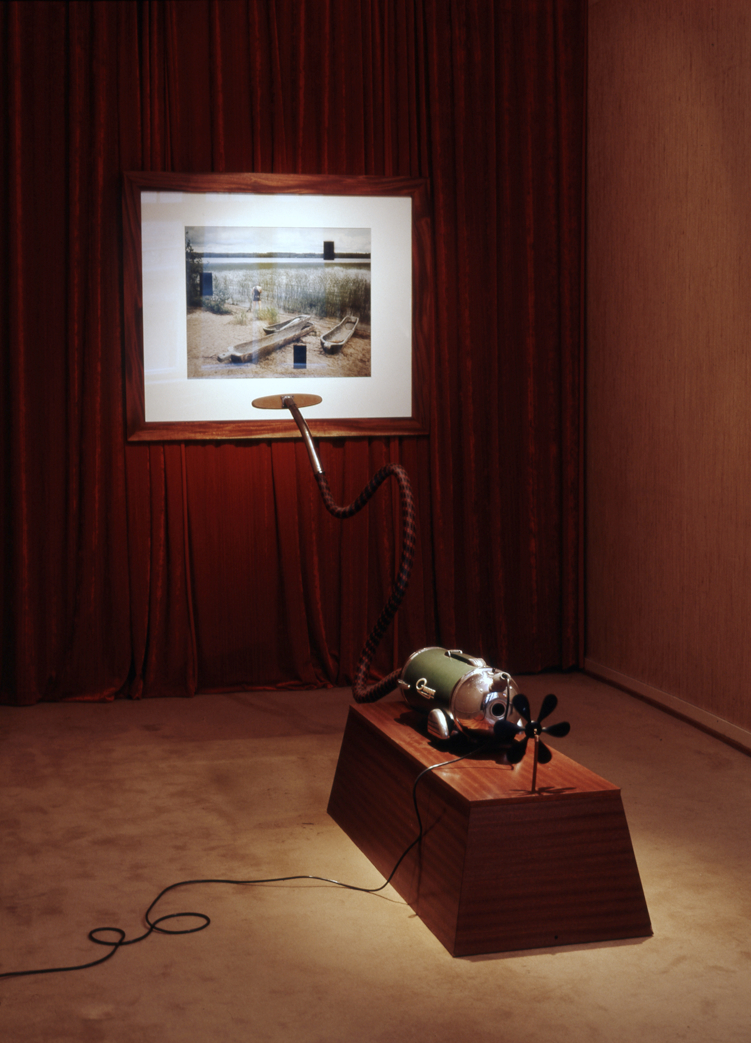
Kyseinen Merkitysimuri- teos on syntynyt näistä pohdinnoista. Se ehkä parodioi pateettista taidekokemusta ja taiteellista ylevää ”esitystä”, mutta on silti koomisuudestaan huolimatta oudosti ylevä ja myös vaikeasti määriteltävänä salaperäinen. Mustat alueet valokuvassa ovat monitulkintaisia ja herättävät kysymyksiä tiedon ja kokemuksen rajallisuudesta.
Merkitysimuri -teos oli myös tekninen laite. Se käynnistyi, kun katsoja painoi imurin käynnistysnappia. Imurin sisältä alkoi kuulua Sibeliuksen musiikkia. Kokemus oli tietysti absurdi. Ylevä musiikki yhdistyi oudosti arjen banaaliin. Laatikon sisällä oli elektronien ohjauslaite, joka ohjasi imurin käyntiä seuraamaan musiikin dynamiikan vaihteluita. Laite puhisi erityisen kovasti, kun musiikki oli kaikkein pateettisimmallaan. Imurin tuottama ilmavirta sai laatikon takareunaan pystytetyn vipperän pyörimään ja vipperä oli hurjimmillaan sinfonian nousevassa finaalissa. Voidaan ehkä sanoa pateettisuuden huipun yhdistyneen banaalisuuden huipentumaan.
Pölynimurin ja teoksen aikaisempi interaktiivisuus (katsoja osallistuu) oli tärkeä elementti, sillä teoksen tekoaikana nimenomaan interaktiivisuus nähtiin uutena ja tärkeänä taideteoksen ominaisuutena. Tuona aikana katsojan tai kirjallisuuden lukijan asemaa korostettiin uudella väitteellä: ”katsoja luo teoksen”. Teoria oli peräisin kirjallisuusteoriasta jo 1960-luvulta, mutta sitä alettiin soveltaa myöhemmin myös taiteeseen. Ajatus ei ollut kuitenkaan teoksen itsenäisyydelle useinkaan eduksi. Teoreettinen keskustelu on sittemmin osin hylännyt tuolloisen argumentin. Ajan trendin innostamana lisätty interaktiiivisuus tuotti kuitenkin toisinaan koomisia teoksia ja tulkintoja taideteoksista, eivätkä ne useinkaan syventäneet teosta tai taidekokemusta.
Teokseen liittyvä valokuva on otettu Saarijärven Kivikauden kylässä. Kuvassa on vastakkaisia elementtejä. Toisaalta se esittää ylevää luontoa ja ihmiskunnan pohjoisessa luonnossa selviytymisen historiaa, mutta toisaalta valokuvassa näkyy myös Kivikauden kylään rakennettu keinotekoinen ja väistämättä myös hieman outo ja koominen ”esitys” ihmisen historiasta.
On the Concept Behind the Work Merkitysimuri (A Vacuum Cleaner of Meanings )
In the early 1990s, photography was actively seeking new forms. While photographers were fascinated by the two-dimensional, almost immaterial, and window-like nature of the photograph, this very quality was also perceived as a limitation to expression. There was a desire to break the photograph out of its frame. Photographs were manipulated mechanically and chemically, and integrated into sculptural frames or combined with other materials and elements. Photography was perhaps viewed as a somewhat ”incomplete” art form, lacking the physicality and the tangible touch of the artist’s hand associated with traditional arts. Consequently, the artistic potential and materiality of photography were explored and developed using entirely new methods.
The work Merkitysimuri emerged from these reflections. While it may parody the grandiose art experience and the ”performance” of the artistic sublime, it remains—despite its comic nature—strangely sublime and, by virtue of being difficult to define, mysterious. The black areas within the photograph are open to multiple interpretations, prompting questions about the limitations of knowledge and experience.
Merkitysimuri also functioned as a technical device. It was activated when a viewer pressed the vacuum cleaner’s power button, causing music by Sibelius to emanate from within the machine. The experience was, naturally, absurd: the sublime music became strangely intertwined with the banality of everyday life. Inside the box was an electronic control unit that regulated the vacuum cleaner’s operation, causing it to respond to the dynamic shifts in the music. The device would wheeze particularly loudly during the most dramatic, pathos-filled passages of the music. The airflow generated by the vacuum caused a small spinner—mounted at the rear of the box—to rotate; this spinner reached its most frenetic pace during the symphony’s swelling finale. One might say that the peak of pathos converged here with the pinnacle of banality.
The interactivity between the vacuum cleaner and the work—involving the viewer—was a significant element, as interactivity was regarded at the time of the work’s creation as a novel and vital attribute of an artwork. During that period, the role of the viewer (or the reader of literature) was emphasized through a new proposition: ”the viewer creates the work.” While this theory originated in literary theory as early as the 1960s, it was later applied to the visual arts as well. Often, however, this concept did not necessarily benefit the autonomy of the work itself. Theoretical discourse has since largely moved away from this particular argument. Driven by the trends of the time, the inclusion of interactivity sometimes resulted in comical works or interpretations, which rarely served to deepen the work or the artistic experience.
The photograph associated with this piece was taken at the Stone Age Village in Saarijärvi. The image contains contrasting elements. On one hand, it presents the sublime natural world and the history of humanity’s survival within the northern wilderness; yet, on the other, the photograph also reveals an artificial—and inevitably somewhat strange and comical—‘performance’ staged within a Stone Age village.

